
Replacing a roof is one of the most significant maintenance projects a property owner can undertake. Whether you are an experienced roofing contractor, a property manager, or a motivated homeowner tackling a DIY tear-off, one universal truth applies to every roofing job: it generates a massive amount of debris.
From heavy asphalt shingles and underlayment to rusted nails and rotted plywood, managing this waste efficiently is critical to keeping your project safe, on schedule, and within budget.
Renting a garbage bin is the most practical solution for handling roofing waste. However, renting a bin for a roofing project is slightly different than renting one for a standard basement cleanout. Roofing materials are exceptionally heavy, and miscalculating your needs can lead to unexpected overweight fees or logistical issues such as running out of bin space mid-project.
This comprehensive guide will walk you through everything you need to know about renting a bin for a roofing project, from calculating your waste and choosing the right size to preparing your property for delivery.
Understanding Roofing Waste
Before you can rent the right bin, you need to understand exactly what you are throwing away. Roofing debris is incredibly dense. The majority of residential roofs use asphalt shingles, which are primarily composed of fiberglass, asphalt, and mineral granules.
When you tear off a roof, your bin will typically need to accommodate:
- Shingles: The bulk of the weight and volume.
- Underlayment: Tar paper or synthetic felt.
- Fasteners: Thousands of roofing nails.
- Flashing and Drip Edge: Aluminum or galvanized steel components.
- Wood Debris: Damaged oriented strand board (OSB), plywood decking, or rotted fascia boards.
Because of the density of asphalt shingles, the primary constraint when renting a roofing bin is usually weight, not volume.
Tips to Start Your Roofing Bin Rental Process
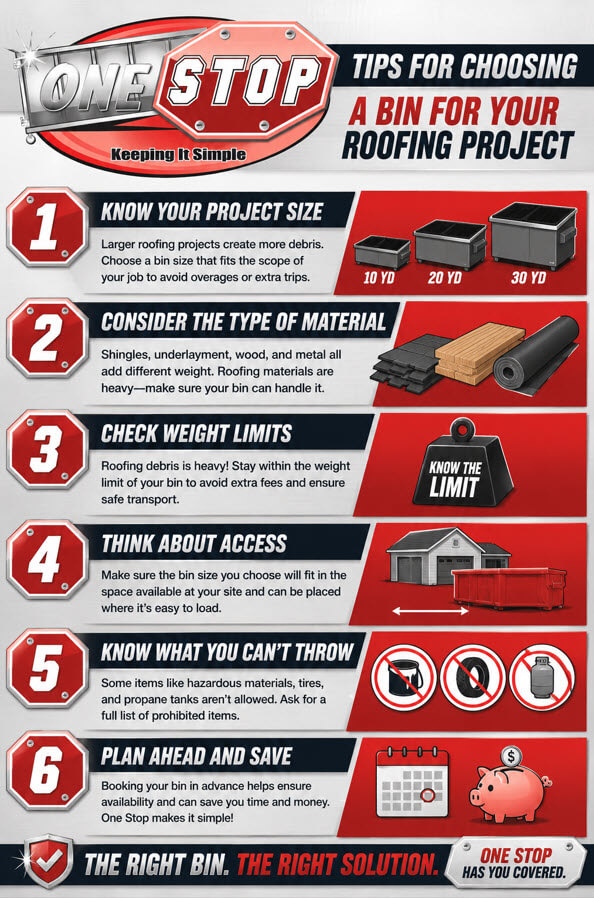
Calculating Your Debris: The “Square” System
Roofers do not measure roofs in standard square feet when quoting materials; they use a measurement called a “square.” One roofing square equals 100 square feet of roof area.
To determine how much debris you will generate, you need to know two things:
- The total number of squares being removed.
- The number of layers being removed. Older homes often have two or even three layers of shingles layered on top of each other.
Estimating Roofing Debris Weight
The type of shingle drastically impacts the weight of your waste:
- 3-Tab Asphalt Shingles: Roughly 250 pounds per square.
- Architectural/Dimensional Shingles: Roughly 350 to 400 pounds per square.
- Slate or Concrete Tiles: Up to 1,000 pounds per square.
If you have a 20-square roof with a single layer of architectural shingles, you will generate approximately 7,000 to 8,000 pounds (3.5 to 4 tons) of debris. If that same roof has two layers, you are looking at 7 to 8 tons.
Choosing the Right Bin Size
Dumpsters are measured in cubic yards, which refers to their internal volume. Selecting the right size is a balancing act between having enough room and staying within the rental company’s legal and safe transport weight limits.
Here is a breakdown of common bin sizes and their typical capacity for roofing projects:
| Bin Size | Typical Capacity (Architectural) | Typical Capacity (3-Tab Asphalt) | Best Use Case |
| 10-Yard | 15–20 Squares | 20–30 Squares | Garages, sheds, small home repairs, or very heavy materials like slate. |
| 15-Yard | 20–30 Squares | 30–40 Squares | Small to medium-sized single-family homes. |
| 20-Yard | 30–40 Squares | 40–50 Squares | Standard mid-to-large single-family homes (The most common roofing bin). |
| 30-Yard | Use with caution | Use with caution | Large commercial flat roofs, wood shake removal, or large cedar roofs. |
Note on large bins for roofing projects: Many rental companies will explicitly forbid you from filling a 30-yard or 40-yard bin to the top with asphalt shingles. The truck’s hydraulic hoist simply cannot lift 15 tons of shingles, and local laws restrict how much weight a commercial truck can legally carry on the road. If you have a massive project, it is often better to rent two 20-yard bins.
The Importance of Weight Limits and Overages
When you receive a quote for a bin rental, it typically includes a set weight allowance (e.g., a 15-yard bin might come with a 2-ton or 3-ton limit included in the base price).
Because roofing is so heavy, you are highly likely to exceed the base weight allowance of a standard residential rental. When this happens, the rental company will charge you a prorated fee for every extra ton (or kilogram) recorded at the local landfill or transfer station.
Ask the rental company if they offer a flat-rate roofing-specific bin. In many regions, clean asphalt shingles can be recycled and used in road paving. If you agree not to mix other household trash in the bin, some companies will offer a flat rate regardless of weight, provided the load consists solely of shingles, nails, and underlayment.
Preparing for Bin Delivery
A bin full of shingles is essentially a multi-ton steel box resting on your property. Proper preparation prevents property damage and ensures a smooth workflow.
- Driveway Protection
Never let a bin sit directly on bare concrete, asphalt, or interlocking pavers. The steel rollers and immense weight can cause cracking or gouging. Instruct the delivery driver to place thick wooden planks (usually 2×6 or 2×8 boards) under the bin’s wheels. Most reputable companies do this by default, but it is wise to confirm.
- Clearance
The delivery truck needs ample room to maneuver, back up, and deploy the roll-off mechanism. You typically need about 60 feet of linear space and 20 to 25 feet of vertical clearance (watch out for low-hanging tree branches and power lines).
- Placement Strategy
Have the bin placed as close to the roofline as safely possible to make tossing debris easier. However, ensure it is not blocking garage access or essential walkways.
Loading the Bin Safely and Efficiently During Roofing Projects
Use the following tips for safe bin use during your roofing work.
- Do Not Overfill
Dumpsters have a clearly marked fill line near the top rim. If you pile debris higher than this line, the driver cannot safely tarp the load, and it becomes illegal for them to transport it. You will be forced to offload the excess by hand before they take it away.
- Distribute Weight Evenly
Try to spread the shingles out evenly across the bottom of the bin rather than piling them all on one side. A lopsided bin is dangerous to load onto the truck.
- Sweep for Nails
Throughout the project, use a heavy-duty magnetic sweeper around the perimeter of the bin. Roofing nails have a tendency to bounce off the edges of the dumpster and land in the driveway, creating a major flat-tire hazard.
Schedule Your Bin Rental Quote with Onestop
Onestop Bin Rental serves clients throughout the Fraser Valley, Lower Mainland, and Greater Vancouver with best-in-class bin rental options. Over our decades of experience, we’ve worked with hundreds of roofing services companies to provide affordable bin rentals within a convenient rental process.
Book your next bin rental with confidence. Schedule a free consultation with Onestop Bin Rental!
Renting a Bin for Roofing Projects – Frequently Asked Questions
What size bin do I need for a 20-square roof?
For a standard 20-square roof with a single layer of shingles, a 15-yard bin is usually the perfect size. It provides enough volume to comfortably hold the debris without exceeding the legal weight limits of the truck. If you have two layers of shingles on that same roof, you should upgrade to a 20-yard bin to handle the extra volume and weight.
Can I mix other household junk with my roofing shingles?
It depends on your rental agreement, but generally, it is not recommended. Mixing household trash, furniture, or yard waste with roofing debris classifies the load as “mixed solid waste.” This prevents the shingles from being recycled and often incurs much higher landfill tipping fees. If you want the most cost-effective rate, keep the bin strictly for roofing waste (shingles, felt, nails, and roof wood).
Do I need a permit to rent a bin for roofing?
You only need a permit if you plan to place the bin on public property, such as the street, a public alleyway, or a sidewalk. If the bin is placed entirely on your private property (such as your driveway or lawn), no permit is required. If street placement is necessary, you or your rental company must contact your local municipality’s parking or public works department to secure a right-of-way permit.
Will the weight of a roofing dumpster damage my driveway?
It is possible if proper precautions aren’t taken. Because roofing bins can easily weigh between 4 and 10 tons when fully loaded, placing them directly on a residential driveway can cause cracks or sinking—especially on hot days when asphalt softens. To prevent this, always insist that wooden planks are placed under the bin’s rollers to distribute the weight.
Can I put hazardous materials or asbestos in the roofing bin?
Absolutely not. Standard roll-off bins are not permitted to transport hazardous waste. If you are tearing off an older roof (pre-1980s) and suspect the roofing tar, cement, or shingles may contain asbestos, you must have it tested first. Asbestos abatement requires specialized contractors, tightly sealed transportation, and specific landfill disposal protocols. Throwing it in a standard bin can result in massive fines and legal liabilities.