
Late autumn and early winter in Metro Vancouver bring severe weather patterns characterized by powerful Pacific windstorms and heavy atmospheric rivers. From West Vancouver and Downtown to Burnaby, Richmond, Surrey, and the Fraser Valley, property owners routinely wake up after severe weather to find property damage, blocked access routes, and vast piles of scattered organic limbs. Managing emergency property cleanouts quickly requires practical knowledge, proper equipment, and an efficient disposal strategy. Partnering with a professional local hauler for a prompt storm debris removal Vancouver service ensures that hazardous limbs, heavy log sections, and wind-damaged building materials are cleared safely and sustainably without violating municipal waste regulations.
As experienced waste management and recycling professionals operating across Greater Vancouver and the Fraser Valley, the team at Onestop Bin Rental regularly assists residential homeowners, strata managers, and commercial property owners following major storm events. Clearing windstorm damage involves more than simply throwing branches into a pile, as local transfer stations maintain strict sorting standards for clean wood, green yard waste, and mixed construction debris. Understanding how to organize your cleanup, select appropriate container capacities, and coordinate rapid haulage will keep your restoration project on track while protecting your property from secondary drainage or structural hazards.
Understanding Metro Vancouver’s Storm Season: Windstorms and Atmospheric Rivers
The geographic position of the Lower Mainland makes the region particularly vulnerable to extreme moisture plumes and severe wind events between October and March. Atmospheric rivers drop intense rainfall over short durations, saturating urban soils and weakening root systems across coastal forests and residential neighbourhoods alike. When soil becomes completely waterlogged, the ground loses its capacity to support the weight of tall urban tree canopies, especially when sudden wind gusts create strong forces against trunk structures.
Property owners face multiple hazards during these severe weather occurrences. Fallen tree trunks can crush perimeter fencing, puncture residential roofing, damage parked vehicles, and block primary driveway corridors. Furthermore, heavy windstorms scatter smaller twigs, pine needles, and saturated leaves across roof gutters and perimeter drainage basins. When drainage systems become clogged with organic debris, surface water accumulates rapidly around building foundations, causing basement flooding and localized water damage. Engaging a dedicated storm debris removal Vancouver provider immediately after a severe storm allows property owners to clear blocked driveways, restore site access, and mitigate secondary water intrusion risks before compounding property damage occurs.
Sorting Organic Yard Waste from General Structural Debris
One of the most common mistakes property owners make during emergency storm cleanups is co-mingling organic tree debris with damaged structural materials. Metro Vancouver transfer stations and regional waste facilities enforce strict regulations regarding material separation to maximize resource recovery and prevent landfill contamination. Unsorted or contaminated loads incur substantial tipping penalty surcharges, which significantly increases overall cleanup expenses.
When executing a storm debris removal Vancouver project, categorizing waste into distinct streams ensures cost-effective disposal and environmental compliance. Organic debris includes clean tree branches, trunk logs, stumps, root balls, brush, and fallen leaves. These organic materials are transported to local composting facilities where they are processed into nutrient-rich soil additives and organic mulch. Conversely, structural debris includes wind-damaged wooden fencing, asphalt shingles, vinyl siding, broken aluminum gutters, and shattered outdoor furniture. Structural items must be processed as mixed construction waste or directed to specialized material recovery streams.
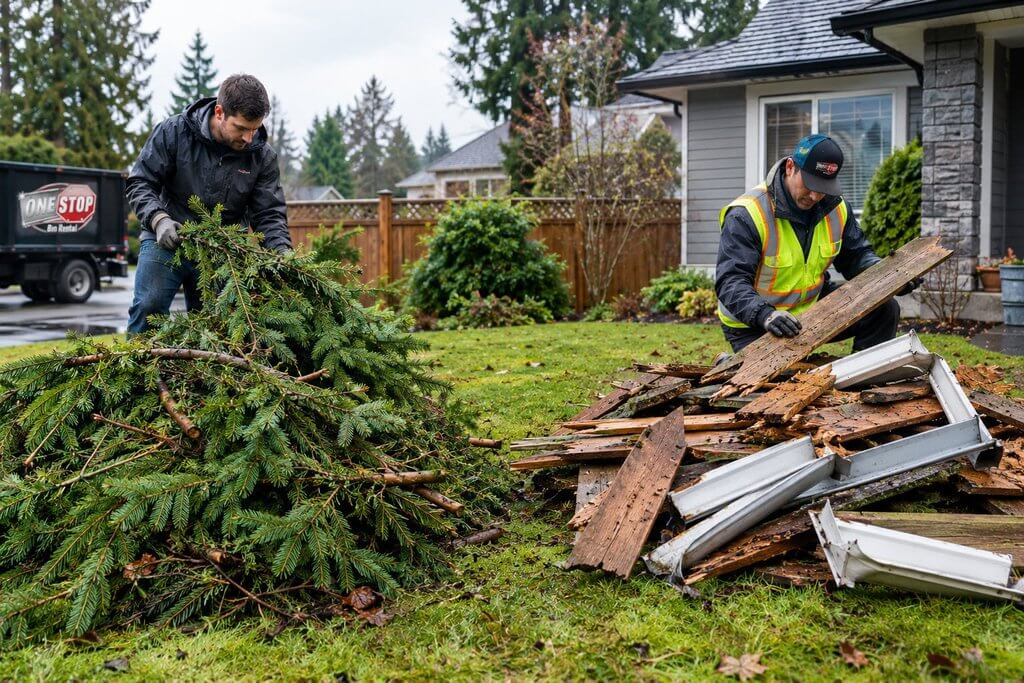
To assist property owners and cleanup crews in organizing their post-storm waste disposal, the table below details the proper separation rules, processing destinations, and key handling considerations for common storm debris categories across the Lower Mainland.
Metro Vancouver Storm Debris Sorting & Disposal Guidelines
| Material Stream | Common Storm Debris Items | Regional Disposal Destination | Key Handling & Separation Rules |
| Clean Organic Green Waste | Tree branches, brush, fallen limbs, leaves, shrubs, garden debris | Regional composting facilities & organic processing plants | Must be free of soil, gravel, pressure-treated lumber, metal fasteners, or plastics. |
| Heavy Wood & Stumps | Large tree trunks, heavy log sections, root balls, thick stumps | Specialized wood grinding & biomass recycling centers | Stumps must have excess dirt removed. Heavy logs require compact, low-sided containers. |
| C&D Structural Materials | Damaged fencing, decking lumber, vinyl siding, broken plywood | Mixed construction & demolition recycling stations | Treated wood, painted lumber, and metal hardware must be kept separate from organic green waste. |
| Metal & Hardware | Aluminum gutters, steel fencing posts, ruined metal shed panels | Scrap metal recovery & metal recycling processors | Clean metal should be set aside for flat-rate or dedicated scrap recovery to minimize landfill fees. |
At Onestop Bin Rental, we emphasize eco-friendly disposal practices by ensuring that all collected green waste and clean wood from your storm debris removal Vancouver job is routed to licensed organic recycling facilities rather than local landfills.
Choosing the Right Bin Size for Downed Trees and Yard Cleanups
Selecting an appropriate disposal container capacity is crucial when planning a storm debris removal Vancouver project. Tree limbs and brush are notoriously bulky, taking up significant volume even when stacked tightly. Conversely, large trunk sections and saturated root balls carry immense physical weight despite occupying smaller volumetric spaces. Choosing a container that matches both the weight density and physical volume of your debris prevents overfilling and eliminates the need for multiple haulage trips.
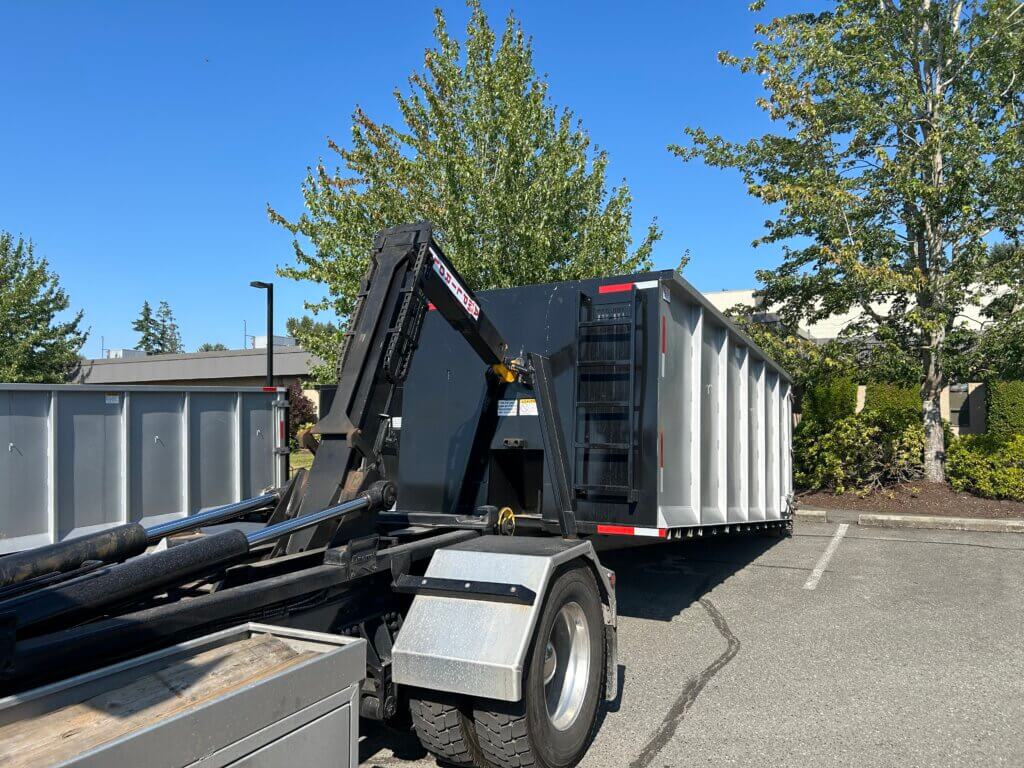
Onestop Bin Rental maintains a versatile fleet of disposal containers ranging from 5 to 30 cubic yards, utilizing precision hooklift delivery trucks capable of placing bins into narrow driveways, alleyways, and restricted residential spaces. Understanding the capacity and weight characteristics of each container size helps you choose the correct equipment for your cleanup effort.
- 5 & 7 Cubic Yard Containers: These compact, low-sided containers are specifically engineered for dense, heavy materials. When dealing with uprooted tree trunks, heavy log sections, rock, or soil-laden root balls, a 5 or 7 cubic yard box prevents exceeding legal gross vehicle weight restrictions while allowing easy manual loading over low side walls.
- 12 & 16 Cubic Yard Containers: Representing the most popular choice for general yard cleanups and moderate windstorm damage, these medium-sized bins handle fallen limbs, branch piles, broken fencing, and damaged siding. The 16 cubic yard model is also available with lockable plastic lids, which prevents rain saturation from adding unnecessary water weight to your green waste.
- 20 & 30 Cubic Yard Containers: Designed for large-scale property clearouts and massive tree failures, these high-capacity bins provide maximum volume for bulky, light-to-medium branches, shattered wooden structures, and widespread storm debris. A 30 cubic yard container holds the equivalent of ten full pickup truck loads, making it ideal for commercial properties, strata complexes, and large residential acreage.
To simplify your equipment selection, the following table outlines recommended container dimensions, weight capacities, and ideal storm cleanup applications for each bin size in our inventory.
Bin Size Selection Matrix for Post-Storm Cleanup Scenarios
| Bin Capacity | Dimensions (L x W x H) | Pickup Load Equivalent | Ideal Storm Cleanup Scenario | Recommended Material Types |
| 5 Cubic Yards | 10’L x 6’W x 2’H | 1.5 Truck Loads | Heavy trunk logs, root balls, saturated soil, masonry | Dense wood logs, rocks, soil, brick, heavy concrete |
| 7 Cubic Yards | 12’L x 8’W x 2’H | 3.25 Truck Loads | Medium trunk sections, small stump removals, stone wall repairs | Heavy tree trunks, gravel, tile, wet soil, dense brush |
| 12 Cubic Yards | 12’L x 8’W x 4’H | 4.0 Truck Loads | Moderate tree branch failure, damaged fencing, yard cleanup | Branches, brush, fencing, decking lumber, general junk |
| 16 Cubic Yards | 12’L x 8’W x 5’H | 5.5 Truck Loads | Multi-tree branch clearance, roofing repairs, lidded storage | Limbs, brush, shingles, vinyl siding, storm debris |
| 20 Cubic Yards | 12’L x 8’W x 6’H | 7.0 Truck Loads | Large downed tree canopy, extensive perimeter fence damage | Bulky branches, cedar hedging, broken structures |
| 30 Cubic Yards | 18’L x 8’W x 6’H | 10.0 Truck Loads | Severe storm destruction, acreage clearouts, commercial sites | Massive volume brush, tree canopies, building waste |
For homeowners who require immediate assistance without loading a container themselves, Onestop Bin Rental also offers full-service junk removal starting at sixty-nine dollars. Our professional crew arrives on-site, loads your storm debris directly into our truck, and hauls it away immediately, leaving your yard clean and safe.
DIY Bin Loading vs. Full-Service Junk Removal: A Cost and Effort Comparison
Deciding between self-loading a rental container and hiring full-service junk removal for a storm debris removal Vancouver cleanup depends on your physical capability, available time, and the weight of the storm debris on your property. Both options provide distinct benefits depending on the scale of your post-storm cleanup project.
To help you choose the best service model for your situation, Table 3 compares self-service bin rentals with full-service junk removal options provided by Onestop Bin Rental.
Comparison of Self-Service Bin Rentals vs. Full-Service Junk Removal
| Feature / Consideration | Self-Service Bin Rental | Full-Service Junk Removal |
| Best For | Multi-day cleanups, extensive branch clearing, large acreage | Single-item pickups, rapid emergency clearance, physical inability to lift |
| Labor Involved | Customer or contractor handles all cutting, carrying, and loading | Onestop Bin Rental crew handles all lifting, loading, and sweeping |
| Time Flexibility | Keep container on-site for 2 to 7 days to work at your own pace | Work completed in a single scheduled appointment window (1-2 hours) |
| Cost Structure | Base rental rate + weight-based disposal fee | All-inclusive flat rate starting at $69 for single items or volume loads |
| Space Required | Requires driveway, parking stall, or street permit placement | Requires temporary truck access during the loading appointment |
Whether you opt for a self-loaded container in Vancouver, a dumpster rental in Burnaby, or full-service junk removal in Richmond, Coquitlam, or Surrey, our team provides fast, local support tailored to your project goals.
Rapid Response and Safe Placement: How to Handle Post-Storm Logistics
Executing a prompt storm debris removal Vancouver operation requires careful attention to site access, equipment placement, and safety protocols. Post-storm conditions often present unique challenges, such as waterlogged driveways, fallen overhead branches, and narrow alleyways restricted by scattered debris.
When scheduling a container delivery after a severe storm, safety must remain your primary priority. Before ordering a bin, inspect the surrounding area for utility infrastructure or site hazards. Always contact local utility authorities if limbs interfere with utility lines to render the area safe before beginning work.
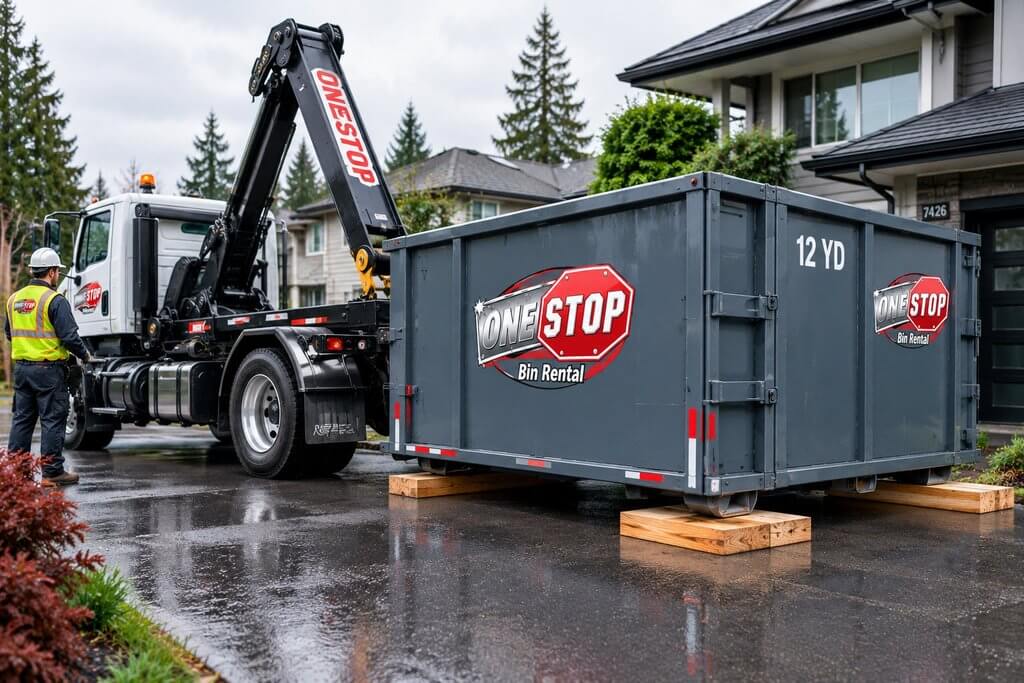
Once safety is established, consider the physical placement of your container. Placing a heavy steel container directly onto saturated lawn areas or soft asphalt can cause surface depression or tire rutting. At Onestop Bin Rental, our experienced delivery drivers utilize specialized wooden dunnage boards beneath the container skids to distribute weight evenly, protecting asphalt, concrete, and brick pavers from structural scarring. Our maneuverable hooklift delivery trucks can place containers into tight residential driveways, carports, or alleyways, ensuring convenient access for loading heavy branches.
To help property managers and homeowners visualize the complete cleanup workflow, our graphic below provides a step-by-step operational spec for managing post-storm waste disposal.
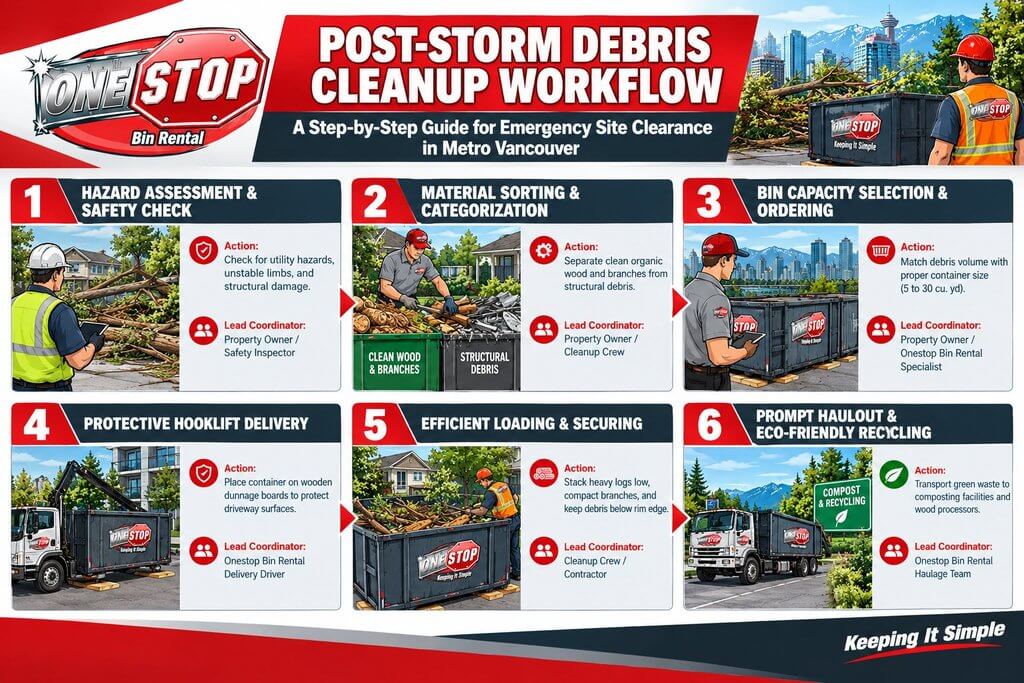
Using a systematic approach ensures that your emergency storm debris removal Vancouver project proceeds smoothly while avoiding site hazards or unnecessary disposal surcharges.
Step-by-Step: Managing a Property Cleanout After Severe Weather
Managing a major property cleanup for a storm debris removal Vancouver project demands a structured strategy to maximize efficiency and minimize physical strain. Following a logical sequence allows you to clear high-priority access zones first while systematically processing scattered yard waste.
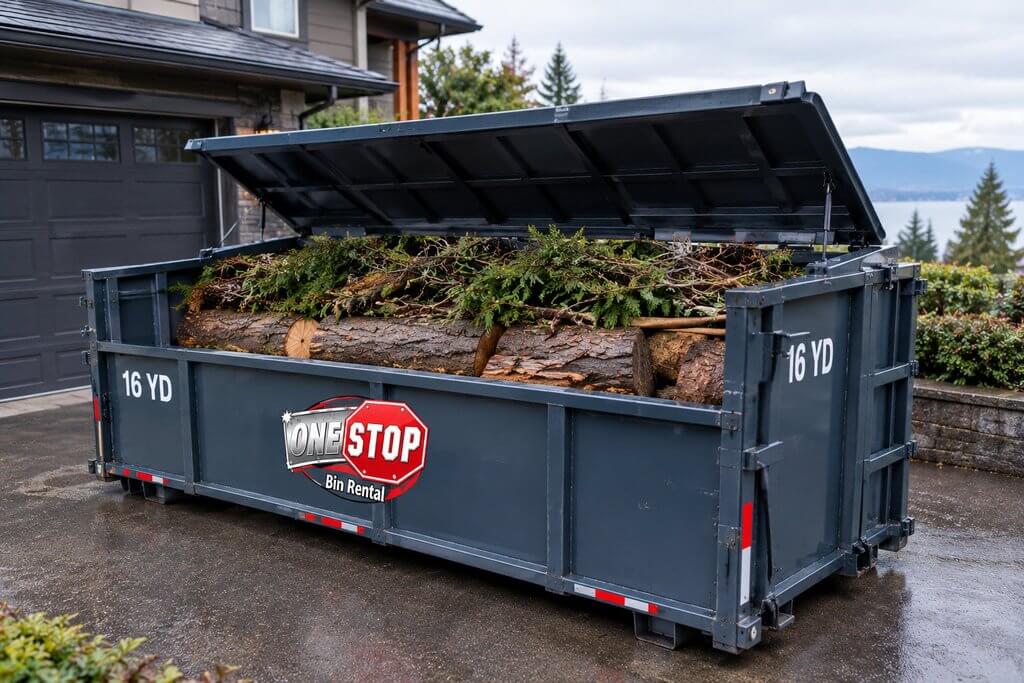
First, establish clear perimeter boundaries around damaged trees or hanging limbs that pose an immediate falling threat. Priority should be given to clearing access routes, such as primary driveways, front walkways, and emergency building exits.
Second, cut large fallen limbs into manageable lengths using cutting tools or hand saws. Trunk logs intended for green waste disposal should be cut into lengths under four feet to facilitate easier manual lifting and compact loading into your rented container. When loading your container, place heavy, dense log sections at the bottom to establish a low center of gravity. Layer lighter branches and brush over the top, compressing the material as you fill the bin to eliminate empty air pockets.
Third, ensure that all loaded waste remains below the top wall edge of the container. Municipal transport regulations prohibit haulers from driving with overflowing containers, as loose branches can dislodge during highway transit and create severe hazards for trailing motorists.
To assist property owners in establishing a safe loading environment, our graphic below outlines essential site safety rules and loading guidelines for container usage.
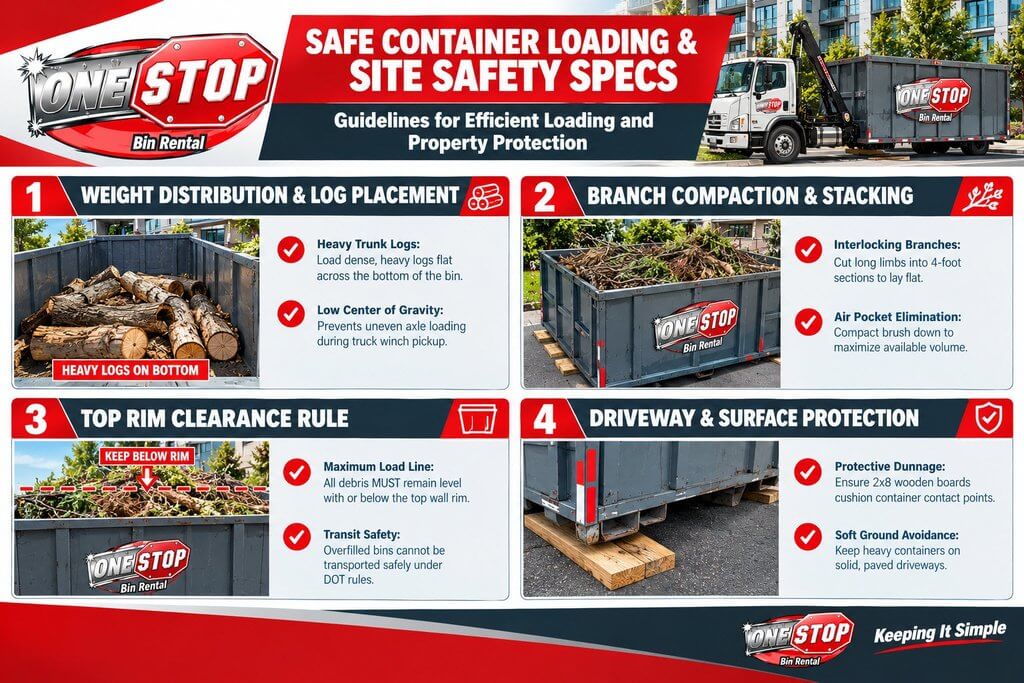
By following these practical loading guidelines during your storm debris removal Vancouver cleanout, you maximize available container space, protect your physical driveway investment, and ensure complete transportation safety.
Mistakes To Avoid During Storm Debris Removal Vancouver
Storm debris removal Vancouver jobs tend to go wrong in the same few ways, and we often see them repeat after every big blow. Avoiding these common mistakes can make yard waste removal safer, easier, and more cost-effective. Keep these points in mind when preparing your debris for pickup.
- Overloading the bin: Never fill a bin above its walls. Overloaded bins cannot be transported safely, and excess material may need to be removed before pickup.
- Mixing hazardous waste with general waste: Metro Vancouver bans items such as asbestos, batteries, paint, and propane tanks from the garbage, according to the City of Richmond’s summary. Check disposal requirements before loading these materials.
- Adding heavy materials to the wrong bin: Soil-heavy root balls can quickly increase the load’s weight and affect how much the bin can safely hold. Confirm that the bin is suitable for the material.
- Cutting near power lines: This is the most dangerous mistake. Never cut branches near power lines yourself. Contact the appropriate utility or a qualified professional.
- Waiting too long after a storm: Bins and cleanup crews can quickly become overbooked after major storms. Piles left for weeks can become wetter, heavier, and harder to sort.
- Assuming every bin accepts every material: Waste acceptance rules vary by bin and provider. Always confirm which materials are permitted before booking or loading a bin.
A little planning goes a long way. Choose the right bin, separate materials properly, and arrange timely pickup to keep your yard cleanup safe and hassle-free.
Frequently Asked Questions (FAQs)
How quickly can I get a bin delivered for emergency storm debris removal in Vancouver?
Onestop Bin Rental provides same-day and next-day container delivery across Greater Vancouver and the Fraser Valley. Our flexible scheduling ensures rapid response following severe windstorms, allowing you to clear hazards and restore property access immediately.
What size bin do I need for a downed tree and fallen branches?
For small-to-medium branch cleanouts, a 12 or 16 cubic yard bin works best. For heavy tree trunks or large root balls, choose a 5 or 7 cubic yard container designed for dense materials and heavy weight loads.
Can I mix tree branches with damaged fencing and roofing materials?
Clean green waste should be kept separate from mixed construction materials whenever possible. Sorting organic limbs from damaged fencing or shingles prevents transfer station contamination penalties and ensures your wood debris is processed at local composting facilities.
Will a heavy bin damage my wet driveway after a storm?
Onestop Bin Rental uses protective wooden dunnage boards underneath steel container skids during drop-off. This technique distributes total weight evenly, preventing asphalt depression, concrete cracking, or surface scratching on wet residential driveways across Metro Vancouver.
What happens if my storm debris exceeds the top edge of the bin?
Containers filled past the top wall rim violate highway transportation safety regulations. Overfilled debris must be trimmed level before pickup, as loose branches can dislodge during transport and pose severe safety hazards for trailing highway motorists.
Does Onestop Bin Rental offer full-service storm debris loading?
Yes, we offer full-service junk removal starting at sixty-nine dollars for property owners who prefer not to load containers themselves. Our professional crew loads your storm debris directly into our truck and hauls it away promptly.
Which areas in the Lower Mainland do you service for storm cleanups?
We service the entire Lower Mainland, including Vancouver, Burnaby, Richmond, Surrey, Langley, Coquitlam, Port Coquitlam, Delta, New Westminster, White Rock, Maple Ridge, North Vancouver, West Vancouver, and surrounding Fraser Valley communities with reliable storm debris removal.
Ready to Clear Your Storm Debris?
Clearing heavy tree branches, uprooted trunks, and wind-damaged building materials after a severe storm does not have to be an overwhelming or stressful experience. By working systematically, sorting organic green waste from structural debris, and selecting the proper container footprint, you can restore your property quickly, safely, and cost-effectively.
At Onestop Bin Rental, we specialize in rapid, reliable, and eco-friendly storm debris removal Vancouver solutions tailored for residential homeowners, strata complexes, and commercial properties across Greater Vancouver and the Fraser Valley. Whether you require a compact 5-cubic-yard rock box for heavy tree trunks, a lidded 16-cubic-yard bin for branch clearance, or full-service junk loading, our experienced team provides prompt delivery, transparent flat-rate pricing, and dedicated customer support.
Tell us about your property cleanout needs today, and we will recommend the ideal bin size and delivery window for your storm cleanup. For fast, affordable, and local disposal services you can depend on, call us at 604-613-5271 or request your free quote online today.